

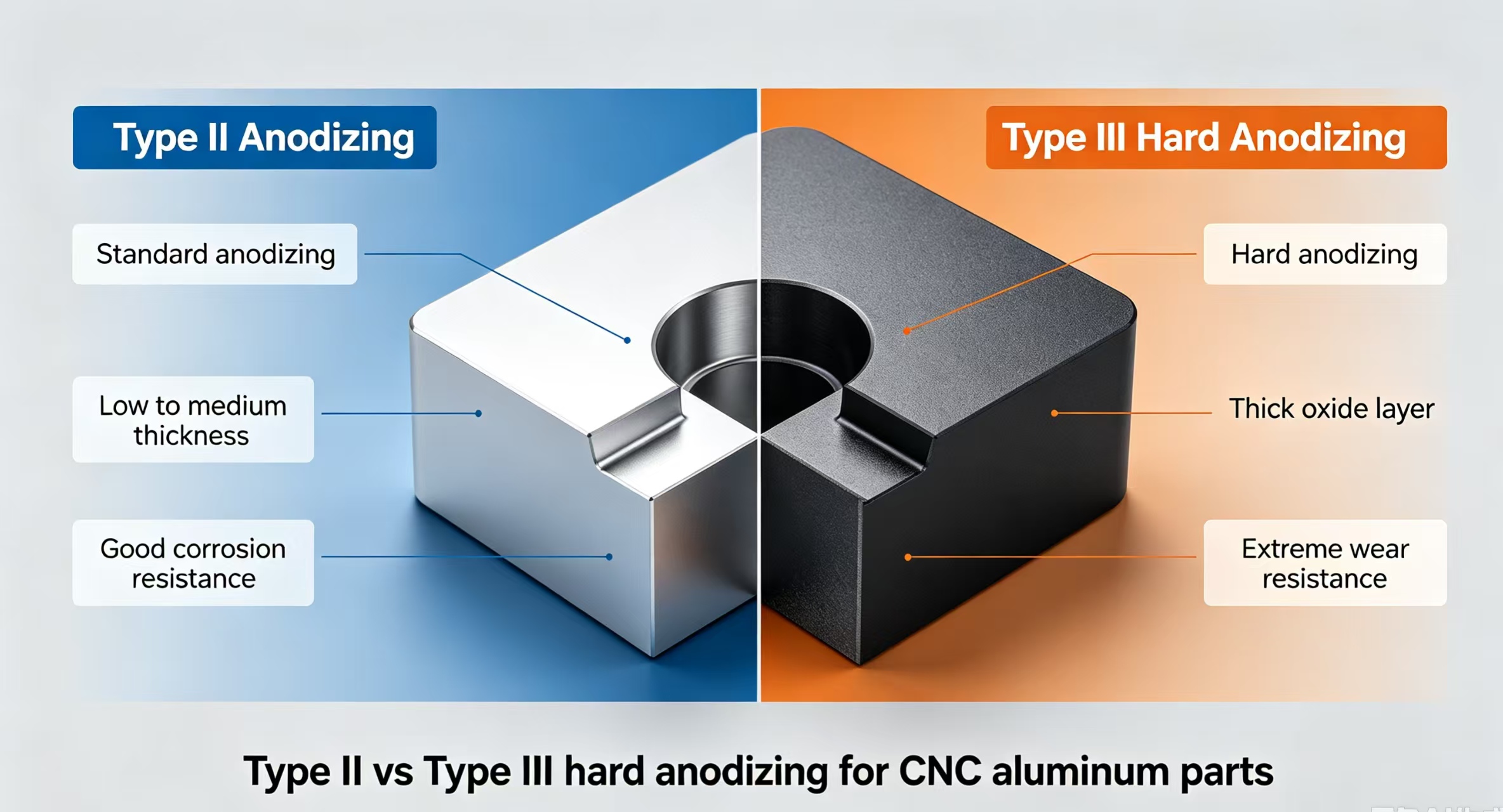
Type II vs. Type III Hard Anodizing: Common Buyer Questions Answered
What Is the Difference Between Type II and Type III?
Buyer: When we customize CNC aluminum parts, we often get confused about Type II anodizing and Type III hard anodizing. What is the basic difference between them?
Engineer: Both processes use electrochemical treatment. They form an aluminum oxide layer on the surface of aluminum parts. However, they serve different performance priorities when evaluating Type II vs Type III hard anodizing.
Type II anodizing is conventional sulfuric acid anodizing. It is commonly selected for:
- General corrosion protection.
- Decorative finishes and color options.
- Consistent appearance.
- Cost‑effective production.
- General‑purpose aluminum components.
Type II creates a relatively thin, porous anodic coating that can be dyed and sealed. It is widely used for consumer electronics housings, equipment panels, brackets and covers. These parts do not need to stand up to severe friction or abrasion.
Type III anodizing, also called hardcoat anodizing, delivers a thicker and harder anodic coating. It uses low‑temperature electrolyte, higher current density and strict process control.
Type III is mainly selected for:
- Higher surface hardness.
- Better abrasion and wear resistance.
- Longer service life under friction.
- Thicker corrosion‑resistant coatings.
- More demanding industrial environments.
In simple terms:
Type II focuses on appearance, general protection and cost control. Type III focuses on wear resistance, coating thickness and mechanical durability.
Type II vs Type III Hard Anodizing: Main Performance Differences
Buyer: What are the key differences in coating thickness, hardness, wear resistance, appearance, dimensional control and cost when comparing Type II vs Type III hard anodizing?
Engineer: Let’s compare the most important factors.
1. Coating thickness
Type II is commonly specified in the range of approximately 5–25 μm. Exact values depend on alloy, process and drawing requirements.
Type III is generally thicker, often specified around 25–100 μm. Actual requirements may vary for different projects. Always write final thickness clearly on engineering drawings or purchase orders.
These numbers are common industry ranges, not fixed values for every part. The MIL‑PRF‑8625 standard and customer drawing take priority.
2. Hardness and wear resistance
Type II provides basic surface protection for normal handling and light scratching. It works well for regular atmospheric exposure. It is not recommended for continuous sliding contact, heavy abrasion or repeated mechanical impact.
Type III forms a denser and substantially harder coating. It fits parts exposed to:
- Sliding contact.
- Repeated friction.
- Abrasive particles.
- Mechanical loading.
- Frequent assembly and disassembly.
- Long‑term industrial use.
Hard anodizing is not a universal wear‑resistant fix. Final performance depends on aluminum alloy, coating thickness, surface preparation and processing conditions.
3. Appearance and color
Choose Type II if appearance and color consistency matter. It supports clear, black, red, blue, gold and other dyed finishes. Results depend on alloy and anodizer process capability.
Type III can also be dyed, most commonly black. But its thick dense coating yields darker, less bright colors. Color matching consistency is poorer compared with Type II.
For that reason, Type III is chosen for functional performance instead of decorative appearance.
4. Corrosion protection
Both Type II and Type III anodizing improve aluminum corrosion resistance.
Type III usually delivers stronger protection thanks to its thicker coating. Still, real‑world performance relies on multiple factors:
- Aluminum alloy composition.
- Coating thickness.
- Sealing treatment.
- Surface defects.
- Environmental exposure.
- Salt‑spray test requirements.
- Handling and assembly conditions.
Do not assume Type III automatically gives superior corrosion resistance in every scenario. Confirm required corrosion performance via defined test methods and customer specifications.
5. Electrical insulation
Anodic oxide delivers a certain level of electrical insulation. Thicker Type III coating creates a stronger dielectric barrier than Type II.
Even so, Type III is not automatically suitable for all electrical or semiconductor hardware. If insulation is critical, list required resistance, dielectric strength and test methods on your drawing.
Semiconductor, vacuum or clean‑equipment buyers should also check:
- Particle generation.
- Coating adhesion.
- Sealing requirements.
- Chemical compatibility.
- Cleanliness level.
- Outgassing or process contamination concerns.
6. Cost and production time
Type II brings lower processing cost and shorter lead‑time. It is economical for high‑volume parts needing appearance or basic corrosion protection.
Type III normally requires:
- Lower bath temperature.
- Higher electrical power.
- Longer processing time.
- More careful fixture design.
- Stricter control of coating thickness.
- More detailed dimensional planning.
As a result, Type III costs more. When comparing Type II vs Type III hard anodizing, evaluate total service life. Picking Type II for high‑wear parts cuts initial cost but raises future replacement and maintenance expense.
Budget planning should always be part of your Type II vs Type III hard anodizing comparison.
What Are Class 1 and Class 2?
Buyer: When we specify MIL‑PRF‑8625, is writing only “Type II” or “Type III” enough?
Engineer: Usually, no. Coating type is only one piece of the anodizing specification.
This standard defines two coating classes:
Class 1: Non‑dyed anodic coating, keeps natural aluminum appearance.
Class 2: Dyed anodic coating, for example black or other defined colors.
Sample drawing callouts:
- MIL‑PRF‑8625 Type II, Class 1.
- MIL‑PRF‑8625 Type II, Class 2, black.
- MIL‑PRF‑8625 Type III, Class 1.
- MIL‑PRF‑8625 Type III, Class 2, black.
Add these details whenever necessary:
- Coating thickness.
- Color requirement.
- Sealing requirement.
- Critical dimensions.
- Masking areas.
- Inspection and testing requirements.
- Certificate or compliance documentation.
If color matching is required, provide approved color standards or physical samples. Color output changes with alloy, surface roughness, coating thickness and anodizing conditions.
How Does Anodizing Affect Dimensions?
Buyer: We are especially concerned about tolerance and assembly. How does Type III affect part dimensions?
Engineer: This is critical for precision CNC machining.
Thick Type III coating will alter features including:
- Outside diameters.
- Bore diameters.
- Thread fit.
- Sliding surfaces.
- Bearing seats.
- Mating faces.
- Precision locating features.
- Small holes and slots.
Oxide grows two‑ways: part of the layer sinks inward into aluminum substrate; another part builds outward and increases outer dimension. Exact shift depends on alloy, coating thickness and process settings.
Never machine parts to final nominal size and then anodize without pre‑planning. For critical features, supplier and buyer should confirm:
- Final dimension target after anodizing.
- Specified coating thickness.
- Machining allowance set before anodizing.
- Which features need masking.
- Post‑anodizing treatment for threads or mating surfaces.
- Final inspection method.
For tight‑tolerance precision bores, mask the bore during anodizing or add pre‑anodizing machining allowance.
Sample drawing note:
MIL‑PRF‑8625 Type III, Class 2, black, coating thickness 25–50 μm. Mask all precision bores and mating surfaces. Dimensions shown are final dimensions after anodizing.
Adjust wording to fit your engineering requirements and confirmed process capability.
Which Applications Use Type II?
Buyer: What types of parts are normally suitable for Type II anodizing?
Engineer: Select Type II for appearance, basic corrosion resistance and cost savings, not extreme wear resistance.
Common applications include:
- Consumer electronics housings.
- Equipment covers and panels.
- Decorative aluminum components.
- Indoor equipment parts.
- General brackets and structural parts.
- Lightweight machine components.
- Aluminum handles and fixtures.
- Non‑critical automotive trim or enclosures.
Type II works for parts seeing light handling and regular atmospheric conditions. If parts run under continuous friction or abrasive wear, evaluate Type III or alternative surface treatments. For more market insight on aluminum components, read our article about CNC aluminum spare parts USA‑2026 market demand.
Which Applications Use Type III?
Buyer: When should we choose Type III hard anodizing?
Engineer: Go with Type III when parts demand improved wear resistance and long‑term surface durability.
Typical examples include:
- Automation equipment components.
- Sliding guides and mechanical contact parts.
- Wear plates and machine fixtures.
- Aerospace components requiring hard, durable surfaces.
- Outdoor industrial components.
- Repeated‑use tooling.
- Parts exposed to abrasion or friction.
- Components requiring a thicker electrically insulating oxide layer.
Industry category alone cannot decide anodizing grade. Not all aerospace parts require Type III, and not all semiconductor hardware needs Type III coating.
Make final selection based on:
- Actual contact and wear conditions.
- Aluminum alloy.
- Required surface hardness.
- Final dimensional tolerance.
- Color requirements.
- Corrosion environment.
- Cleanliness requirements.
- Customer drawing and approval standards.
What Mistakes Should Buyers Avoid?
When working through Type II vs Type III hard anodizing selection, buyers repeatedly run into these common mistakes.
Mistake 1: Using Type II for high‑wear applications
Continuous friction and sliding wear will wear Type II coating prematurely. Parts lose protective surface and need early replacement.
Mistake 2: Choosing Type III for decorative parts
Type III creates darker, less predictable surface appearance. If bright color and precise color‑match are top priority, Type II is usually better.
Mistake 3: Ignoring coating thickness
Thick Type III coating changes bores, threads, shafts and mating surfaces. Without pre‑machining planning, finished parts will fail assembly.
Mistake 4: Specifying only “black anodized”
“Black anodized” is incomplete. Drawings must define anodizing type, class, color, plus thickness and sealing rules when needed.
Mistake 5: Assuming all aluminum alloys anodize the same way
Different alloys deliver different color output and coating uniformity. Some alloys are harder to anodize consistently.
Mistake 6: Forgetting masking requirements
Precision bores, threads, electrical contacts and mating surfaces may require masking. Missing masking notes will break assembly or function.
Mistake 7: Treating Type III as a universal solution
Type III improves wear resistance, yet it is not ideal for bright colors, tight bare‑metal tolerances, strict cosmetic standards or special clean‑room processes.
Also read our guide for CNC aluminum material selection tips.
Use this quick‑reference table to speed‑up your Type II vs Type III hard anodizing selection for CNC machined parts.
Quick Selection Guide
| Your main requirement | Recommended starting point |
|---|---|
| Decorative appearance and multiple color choices | Type II, Class 2 |
| Natural aluminum appearance and general protection | Type II, Class 1 |
| General indoor equipment parts | Type II |
| Continuous friction or sliding contact | Type III |
| Higher surface hardness and wear resistance | Type III |
| Thick functional coating for industrial service | Type III |
| Tight precision fits | Type II or Type III with masking and dimensional planning |
| Bright, highly consistent color matching | Usually Type II |
| Harsh environment or abrasive service | Consider Type III, subject to testing and specification |
Final Recommendation
Buyer: What is the simplest way to choose between the two?
Engineer: Start with real‑world part function for your Type II vs Type III hard anodizing evaluation.
Choose Type II anodizing when the part mainly requires:
- Decorative appearance.
- Multiple color options.
- General corrosion protection.
- Moderate surface protection.
- Lower processing cost.
Choose Type III hard anodizing when the part mainly requires:
- Higher wear resistance.
- Greater surface hardness.
- Thicker functional coating.
- Long‑term performance under friction.
- Improved durability in demanding industrial service.
Do not finish specification only with “Type II” or “Type III”. Before production confirm MIL‑PRF‑8625 type, class, color, coating thickness, sealing requirement, masking areas and final dimensions.
In short:
Type II = appearance, general protection and cost efficiency.
Type III = thicker coating, higher wear resistance and industrial durability.