

Outgassing Control for Semiconductor CNC Parts
Introduction
Controlling outgassing for semiconductor CNC parts starts with material selection and disciplined machining practices.
For semiconductor vacuum equipment, even the tiniest amount of trapped volatile contaminants can ruin wafer processing. When molecules trapped inside machined components slowly release into a vacuum environment, this phenomenon is known as outgassing.
Excessive outgassing causes film contamination, particle generation, pressure instability, and reduced process yield. It does not matter how precise your CNC tolerances are if your vacuum parts release gas after assembly.
Semiconductor OEMs and system integrators always require strict outgassing compliance for high and ultra-high vacuum (HV / UHV) chambers, flanges, manifolds and internal hardware. This article builds on our guide to vacuum chamber and flange CNC machining, and breaks down practical, manufacturable best practices for outgassing control in custom CNC machined semiconductor parts.
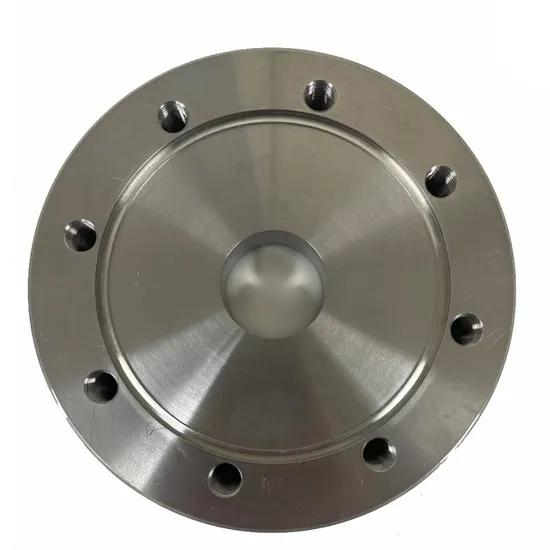
What Is Outgassing, and Why It Matters for Semiconductor Vacuum Systems
Outgassing comes from volatile organic compounds (VOCs), residual cutting fluids, trapped moisture, plastic additives, or impurities embedded within the bulk material or surface pores. Under low-pressure vacuum conditions, these contaminants vaporize and escape.
Common consequences for semiconductor tools:
- Contamination of wafer surfaces during etching, deposition or ion implantation
- Longer pump-down time and inability to reach target vacuum pressure
- Unstable process parameters and inconsistent batch yield
- Degradation of optical windows, seals and sensitive sensors
Not all vacuum applications share the same outgassing requirements. Rough vacuum systems have looser rules, while UHV process chambers demand extremely low total mass loss (TML) and collected volatile condensable materials (CVCM) values, usually tested per ASTM E595 standard.
Low-Outgassing Material Selection for Semiconductor CNC Machined Parts
Material choice is the foundation of outgassing control. The best precision machining alloy will fail if it contains high levels of organic additives or bulk impurities.
Aluminum Alloys
6061 Aluminum
The most widely used option for semiconductor vacuum hardware. It has good machinability, low bulk outgassing, and forms a stable, dense oxide layer. Proper hard anodizing (Type III) further seals the surface pores to reduce outgassing.
Note: Avoid non-certified aluminum stock with residual lubricants or segregation impurities.
5052 Aluminum
Good corrosion resistance and fine grain structure. It works well for non-UHV vacuum components, but less popular than 6061 for heavy CNC machining of large vacuum chambers.
Stainless Steel
304 / 316L Stainless Steel
Excellent for UHV applications. 316L offers superior corrosion resistance. Stainless steel has very low intrinsic outgassing, but it is harder to machine. Longer machining cycles create more surface microcracks that can trap cutting fluids, demanding stricter post-machining cleaning and bake-out.
Titanium
Titanium delivers ultra-low outgassing and high temperature stability. It is ideal for high-heat vacuum process environments. The downside is high raw material cost and slower CNC machining, reserved for critical small-batch components.
❌ Materials to avoid for high / ultra-high vacuum: Standard plastics, rubber, composite materials, and some free-machining alloys with high lead or sulfur content. These materials release large volumes of volatiles under vacuum.
CNC Machining Process Controls to Minimize Trapped Contaminants
Material selection alone is not enough. Your machining workflow directly impacts how much contamination gets trapped in surface micro-pores. Proper machining control keeps semiconductor CNC parts free of trapped cutting residues.
- Use vacuum-grade cutting fluids
Standard heavy-duty cutting oils leave organic residues deep in micro-grooves. Switch to low-outgassing, low-residue coolants for semiconductor vacuum jobs. - Sharp cutting tools & optimized feed rates
Dull tools tear material instead of cleanly shearing it. Torn surfaces create microcavities that trap oil and debris. Sharp end mills produce cleaner surface finishes and reduce contaminant entrapment. - Deburr thoroughly without silicone-based media
Manual or abrasive tumble deburring with silicone-containing compounds introduces persistent VOC contamination. We use stainless steel media or ultrasonic deburring for vacuum parts. - Separate production batches
Keep semiconductor vacuum parts isolated from general machining workpieces to prevent cross-contamination from grease, oil and particles from other jobs.
Surface Finishing, Cleaning & Bake-Out Protocols
For semiconductor CNC parts, surface finishing and bake-out are critical steps to achieve ultra-low outgassing performance.
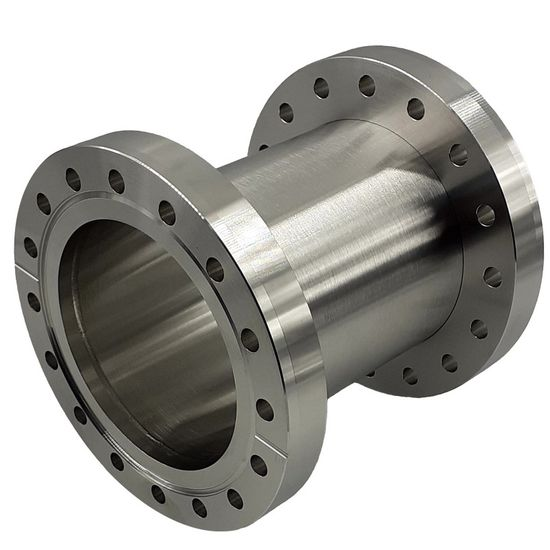
Surface treatment and post-processing are critical final steps to reduce outgassing.
Surface Finish
Smoother Ra values reduce surface area and reduce the amount of trapped contaminants. For UHV sealing faces, fine machining or polishing is required.
Type III hard anodizing is preferred over Type II for aluminum vacuum parts, as it closes surface pores. You can read more about Type III hard anodizing for precision components in our related article.
Precision Cleaning
A multi-stage cleaning sequence is standard: solvent rinse → alkaline wash → DI water rinse → hot air drying inside a cleanroom environment. All cleaning agents must be low-outgassing certified.
Vacuum Bake-Out
Bake-out heats components under vacuum to drive off trapped moisture and volatiles before final assembly. Bake-out cycles are commonly specified at 100–200°C, depending on alloy and end application. This step permanently lowers the outgassing rate of the finished part.
Common Specification Mistakes Engineers Make
- Only specifying tolerance and surface roughness, missing outgassing requirements (TML / CVCM).
- Selecting cheap general-purpose aluminum stock for UHV chambers.
- Using standard cutting fluids and no dedicated cleaning procedure.
- Specifying Type II soft anodizing for UHV aluminum components, which has porous layers.
- Forgetting bake-out requirements in the drawing, leading to parts that cannot reach target vacuum pressure.
CNC Machining Capabilities for Low-Outgassing Semiconductor CNC Parts
HS CNC manufactures low-outgassing semiconductor CNC parts with certified material sourcing and cleanroom handling. We specialize in custom precision CNC machining for semiconductor vacuum equipment. We support:
- Low-outgassing material sourcing with material certificates
- Tight tolerance machining for vacuum chambers, flanges and manifolds
- Cleanroom precision cleaning, controlled bake-out and Type III hard anodizing
- Full inspection reports: CMM dimensional reports, surface roughness test records
- Compliance support for ASTM E595 outgassing testing
We work closely with semiconductor equipment designers to review drawings early in the DFM phase, identify potential outgassing risks, and adjust machining processes before production starts.
Conclusion
Semiconductor CNC parts demand a full-stack approach to outgassing control. Outgassing control is a full-stack engineering challenge, covering material selection, CNC machining strategy, surface finishing and post-process cleaning. A well-controlled workflow eliminates hidden gas release, stabilizes vacuum performance and protects wafer yield.
When designing your next semiconductor vacuum component, evaluate outgassing requirements at the earliest design stage rather than treating it as an afterthought.
If you have custom vacuum CNC parts for semiconductor equipment, contact our engineering team for DFM review and quotation.