
Ultimate Guide to Precision CNC Machined Semiconductor Crucibles: 7 Key Facts for Wafer Fab Engineers

Semiconductor crucibles are mission-critical carrier components for monocrystalline silicon growth, epitaxial deposition, and thin-film wafer processing. In modern fabs, high-precision CNC machining remains the only reliable manufacturing method to meet the extreme demands of ultra-clean, high-temperature, and vacuum environments.

This guide delivers 7 evidence-based facts that equipment buyers, process engineers, and supply chain managers need to know before sourcing custom semiconductor crucibles.

1. Core Applications of Custom Semiconductor Crucibles

When sourcing custom semiconductor crucibles, wafer fabs demand uncompromising precision, purity, and thermal stability.

Single Crystal Silicon Growth (Czochralski Process)
Large-diameter crucibles serve as molten silicon containers during crystal pulling. Inner surfaces demand burr-free finishes with Ra ≤ 0.8μm to prevent particle shedding, which directly causes wafer dislocations and yield loss.

Epitaxy & Thin-Film Deposition
Precision miniature crucibles are installed inside vacuum deposition chambers, holding metal or semiconductor source materials under continuous high-temperature, high-vacuum conditions with minimal outgassing.

Compound Semiconductor & Advanced Packaging
For GaN, SiC (third-generation chips) and wafer-level packaging, crucibles require exact thermal expansion matching and chemical inertness to eliminate machining-induced contamination.

2. Material Options for Custom Semiconductor Crucibles

We support precision CNC processing of **custom semiconductor crucibles** across all major material categories:

Different wafer fabrication processes demand dedicated crucible materials. We support precision CNC processing across all major material categories:
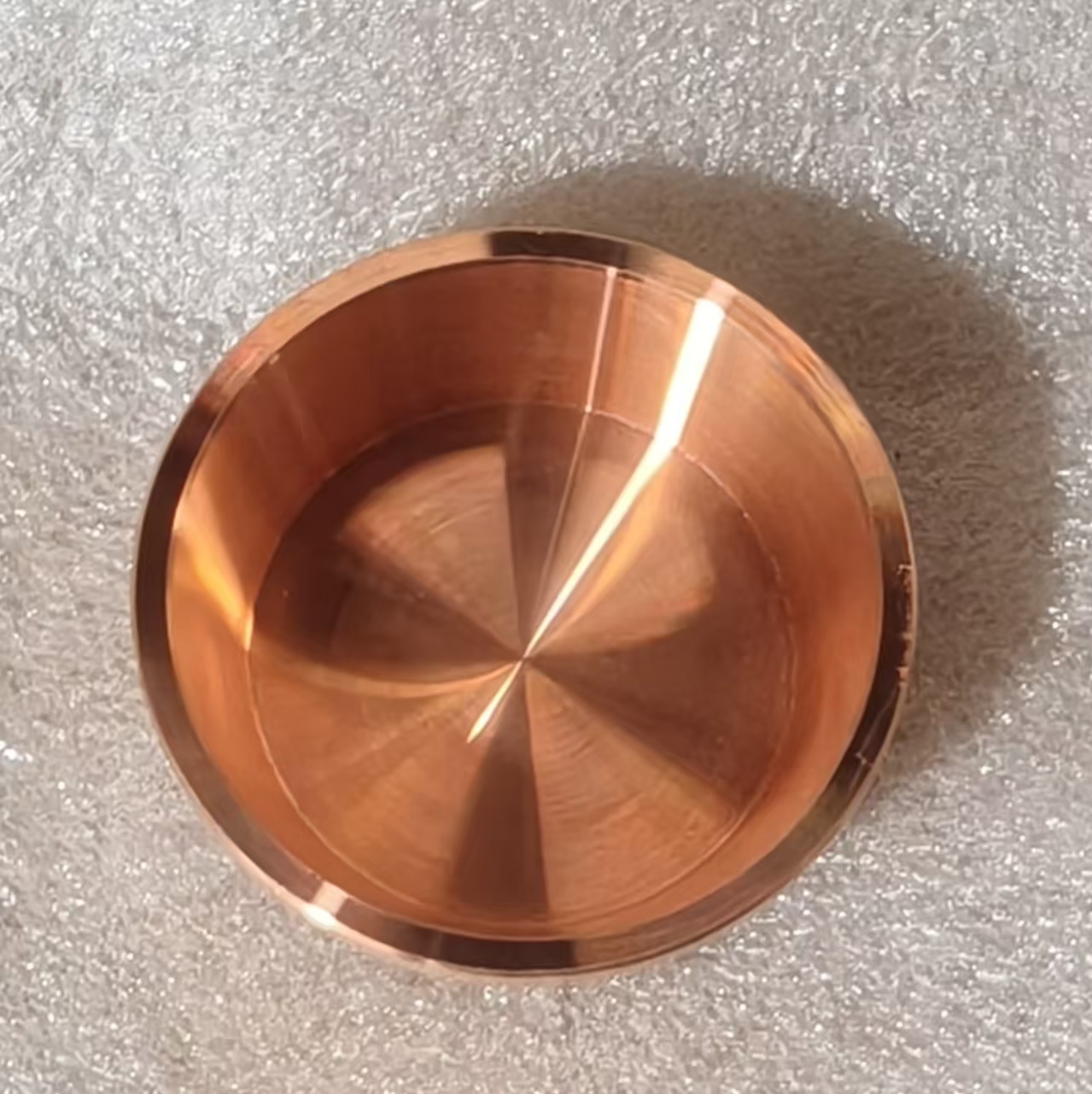
Semiconductor Crucible Material Comparison Chart: High-Purity Graphite, Refractory Metals, Quartz Fused Silica, Advanced Ceramics for Wafer Fabrication
Material Category Representative Grades Key Advantages Primary Applications
High-Purity Graphite Isostatic Graphite Withstands >3000°C, excellent thermal shock resistance, easy to machine Czochralski silicon pulling (mainstream choice)
Refractory Metals Tantalum (Ta), Molybdenum (Mo) Ultra-high vacuum compatibility, corrosion-resistant against molten semiconductors MBE, MOCVD, and advanced epitaxy tools
Quartz / Fused Silica Transparent SiO₂ Low CTE, optically transparent for in-situ observation R&D prototyping, small-batch pilot runs
Advanced Ceramics Alumina (Al₂O₃), Silicon Carbide (SiC) High hardness, low particle generation, chemically inert Advanced packaging, micro-wafer transfer processes

Compliance Commitment: All raw materials strictly follow SEMI International Standards (www.semi.org). We provide lot-specific purity test reports meeting Class 1 cleanroom entry requirements.

3. Precision Tolerance Standards That Exceed Industry Benchmarks

Semiconductor crucibles are not ordinary mechanical components—their geometric accuracy directly dictates thermal field uniformity and crystal quality. Our machining benchmarks:

Parameter Tolerance Standard Process Impact
Inner Wall Roundness & Flatness ≤ ±0.002 mm Ensures stable melt convection and thermal symmetry
Wall Thickness Uniformity Deviation ≤ 0.001 mm Prevents localized overheating and crucible fracture
Surface Finish Mirror-like, burr-free (Ra ≤ 0.4μm optional) Eliminates particle shedding and metal debris
100% Inspection CMM report + surface roughness profile included per batch Full traceability for fab audit compliance

4. Custom CNC Machining Capabilities: From Prototype to Production

We understand that semiconductor equipment is rarely off-the-shelf. Our flexible custom manufacturing covers:

  • R&D Micro-Prototypes: Diameter 20mm – 100mm, minimum order quantity (MOQ) = 1 piece, with rapid 7-day turnaround for process validation.

  • Production-Grade Large Crucibles: Diameter 200mm – 800mm, supporting 12-inch wafer fab expansion needs.

  • Complex Geometries: Internal stepped profiles, custom locating grooves, mounting flanges compatible with major equipment platforms (Kokusai, Applied Materials, Lam Research).

5. Post-Machining Cleanroom Processing: Preventing Contamination at the Source

CNC cutting is only half the story—post-processing cleanliness determines final crucible quality. We implement a 4-stage ultra-clean protocol:

  1. Ultrasonic Degreasing: Complete removal of cutting fluids and oil residues.

  2. 18.2MΩ·cm Deionized Water Rinsing: Dissolves and eliminates surface ionic contaminants.

  3. Vacuum Baking: Outgases volatile organic compounds (VOCs) adsorbed within the material matrix.

  4. Class 100 (ISO 5) Cleanroom Double-Bagging: Vacuum-sealed packaging prevents airborne particle recontamination during transit.

6. Five Catastrophic Failure Modes Caused by Substandard Crucibles

Purchasing decisions based solely on price—without verifying precision and purity—can trigger massive wafer scrappage and tool downtime:

Failure Mode Consequence Estimated Yield Impact
Rough Inner Walls Particle shedding causes surface pinholes and electrical shorts ≥30% yield loss
Non-Uniform Wall Thickness Thermal distortion under high temperature → crystal pull failure Batch abortion
Impure Raw Materials Volatile metal ions (Na⁺, K⁺) released → circuit doping contamination Entire lot rejection
Flange Dimensional Mismatch Vacuum chamber leakage → deposition process collapse Tool downtime >8 hours
Poor Batch-to-Batch Consistency Unstable thermal performance → unrepeatable process parameters Extended R&D cycles

7. Why Partner With Us for Your Semiconductor Crucible CNC Orders

  • Advanced Machine Fleet: 3-axis, 4-axis, and 5-axis simultaneous CNC systems, capable of both large-diameter rotary bodies and micro-feature precision cavities.

  • Dedicated Clean Finishing Workshop: Physically isolated from standard machining areas to eliminate cross-contamination risks.

  • Flexible Commercial Terms: Low MOQ (1 piece accepted), rapid prototyping support, and volume pricing for production runs.

  • Global OEM/ODM Track Record: Long-term supplier to leading semiconductor capital equipment manufacturers worldwide.

Conclusion & Call-to-Action

Custom semiconductor crucibles are irreplaceable core components in wafer fabrication equipment. Only a supplier with full material coverage, micron-level CNC precision, and terminal cleanroom assurance can help you maximize yield and equipment utilization.

Contact our engineering team today with your process parameters or equipment drawings. We will provide:
✅ Material selection recommendations backed by data
✅ Design for Manufacturing (DFM) feasibility review
✅ Competitive quotation with transparent lead-time

Frequently Asked Questions (FAQ)

What is a custom semiconductor crucible used for?
It holds high-purity materials during silicon crystal growth, epitaxial deposition, and purification processes within wafer fabs.

Which crucible material is best for semiconductor applications?
The optimal choice depends on your specific process—graphite for Czochralski pulling, refractory metals for UHV epitaxy, quartz for R&D, and ceramics for advanced packaging. We offer all four categories.

Why is purity so critical for semiconductor crucibles?
Trace contamination (parts-per-billion level) can alter electrical properties of chips, causing parametric failures and catastrophic yield loss.

Can semiconductor crucibles be custom machined?
Yes. We support full customization by diameter (20mm–800mm), material grade, wall thickness profile, and mounting interface geometry.

What CNC tolerances can you achieve on crucibles?
We routinely hold inner wall roundness ≤ ±0.002mm and wall thickness deviation ≤ 0.001mm, with mirror-like surface finishes available upon request.

Leave a Comment

Your email address will not be published. Required fields are marked *

Scroll to Top